
Why Your Pipeline Fails: The Hidden Power of the Buying Journey
- bthomasburns
- Sep 16, 2025
- 7 min read

The revenue pipeline is an extraordinarily important tool in every company. If used properly it can streamline the delivery process, support customer satisfaction, and help forecast future revenue. Done poorly, it will have major consequences that most sales, marketing, and leadership teams do not foresee.
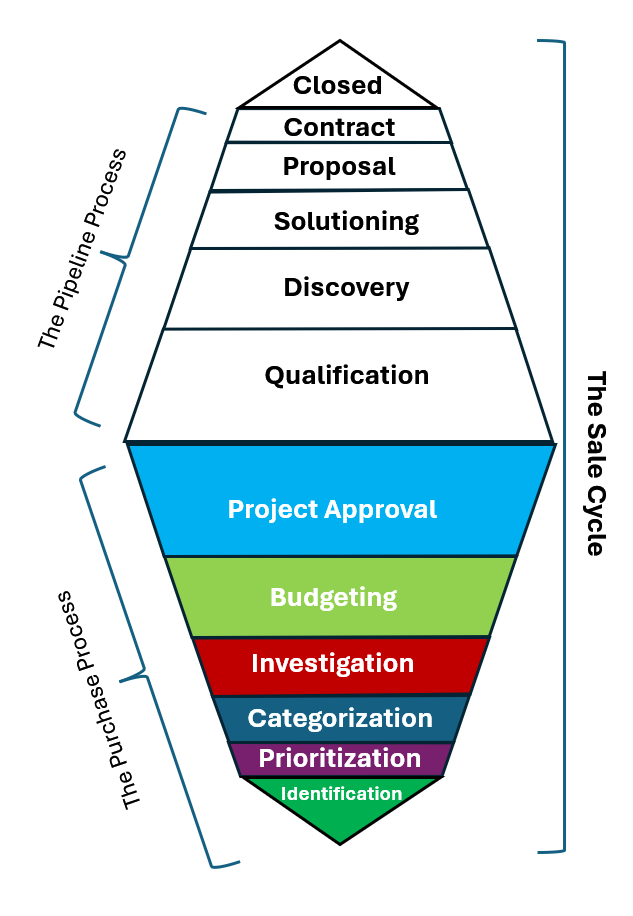
A helpful metaphor for the Sales Cycle is the iceberg. The visible tip above the water represents the stages that sales teams focus on: Qualifying, Discovery, Solutioning, Proposal, and Contract. Leading to the final “closed won/lost” stage. Beneath the waterline, however, lies the customer’s purchasing process. This hidden process drives real buying behavior, and when sales teams ignore it, forecasting accuracy and deal success suffer.
Most organizations track a “standard” Sales Cycle timeline. In the MSP and Professional Services space, 90–120 days is often the benchmark. But when deals age beyond 180 days, many leaders dismiss them as dead opportunities. The real problem? The Sales Cycle and the customer’s purchasing process do not align.

Sales and Executive Leadership are so concerned with the sale cycle metrics that they ignore the important stages of the potential client's buying process. Large enterprises typically follow a formal procurement path, while small and midsize companies may be less structured. But in all cases, buyers follow a series of steps that sellers must understand if they want to succeed.
A Typical Purchasing Process:
1. Identification: Business leaders will identify issues, problems, challenges, or opportunities for innovations. Each represents potential work to be done.
2. Prioritization: The "potential work" is evaluated, prioritized, and assessed for risk, impact and urgency.
3. Categorization: Work is classified into four categories:
Internal, low priority
Internal, high priority
Requires vendor, low priority
Requires vendor, high priority
4. Investigation: For vendor-required work, informal research begins, often without direct sales engagement. Prospects may use websites, AI tools, prior vendor relationships, or market leaders to explore options and gain a sense of cost.
5. Budgeting: Projects move into the budgeting process, often during annual or semi-annual planning. Discretionary budgets may exist but are usually limited.
6. Project Approval: Leadership allocates funds and approves the project for execution.
7. Project Initiation: Internal teams are assigned, requirements documented, and vendors formally engaged. For many salespeople, this may be the first time they have engaged in the process.
8. Vendor Decision: Buyers evaluate vendors against budget, features, value, contract terms, and stakeholder preferences.
9. Contract Execution: Legal and procurement finalize agreements.
10. Project Kickoff: Vendor-led implementation engagement.
The duration of this process is different in every organization but could take as long as a year!

Why the Purchasing Process matters to the Sales Team:
The purchasing process guides the Sales Cycle. Identifying the current stage of the buying process will help the salesperson structure the sales strategy, properly forecast, and ultimately build trust with the potential client.
When any salesperson finds an organization that has a need that aligns with their solution, they get excited! They also tend to interpret this as the start of the sale cycle and add the opportunity to the pipeline. This is especially true when the potential customer is prematurely asking about pricing. The salesperson will jump right into technical discovery activities, and proposal development. This will result in the opportunity stagnating in the proposal stage for 6 months. To avoid false starts salespeople need to define where they are in their procurement process. A couple of simple questions can elucidate which stage they are in.
Has this project been submitted to your budget process?
This question will tell you if the potential client is actively engaged in solving the problem. If the answer is yes, we may be behind the competition and need to start playing defense by establishing our approach, methodologies, differentiators now. If the answer is no, we are early and should have the ability to set the standard for others to try and compete. We should also ask a follow-up question:
What does that process look like?
Those two questions will meet any BANT qualification process. The answer also provides a guide to execute your sales process. This answer will identify stakeholders in the process, timelines, budget criteria, and next steps.
Why are you looking outside the organization to solve this problem?
The Salesperson does NOT want to ask this question, but they should because someone in the budgeting process will. The response will provide insights into the work they want to execute internally and what they want to outsource. If you understand their internal capabilities and gaps, you can customize your solution to match their objectives perfectly and establish your organization as the go-to-partner. This is especially true if the salesperson is very early in their purchasing process, but this will require patience.
Have you formally or informally engaged vendors in the space?
If the answer is yes, you have competition. Find out who is in the game. If possible, talk to the marketing team and find out what webpages have been viewed by prospect and competitor domains. If the budget has been approved, the purchasing process is in the Project Kickoff phase. The opportunity may be added to the pipeline, but I recommend communicating to leadership that we are late to the game to set expectations appropriately. The sales and leadership team will want to build a solution strategy that will disrupt the competitor's advantage.
Why the Purchasing Process matters to the Marketing Team
One of the greatest challenges for any marketing team is establishing the “Brand” in the marketplace. It is incredibly difficult to get the stars to align: Potential customer has a problem; we are one of the companies that they think can solve it.
The Marketing Team should be obsessed with the purchasing process. Especially, the first four stages: Identification, Prioritization, Categorization, and Investigation. The marketing team should be building content and campaigns that address each phase in the process.
Identification and Prioritization
Marketers need to be heavily focused on the problems our target customers are faced with. We need to understand the work that our target customers are doing. We need to understand the value of that work and the pains they experience from that effort. How and when do organizations encounter the problem? Is there a common catalyst that we have addressed with our current customer base?
If we can effectively communicate our understanding of the problem, we can establish our brand as a potential solution worthy of investigation. Getting the timing right is difficult, but marketing strategies that focus on clearly quantifying customer challenges, detailing the consequences of failure to resolve, and highlighting return on investment can establish a root of connection.
Categorization
The question of insourcing vs. outsourcing the solution is an ever-present blocker. The Marketing team should be constantly communicating an outsourced solution will be higher quality and more effective due to our specialized expertise and practiced execution.
Investigation
This is a very critical stage for the Marketing Team. The first step in any vendor investigation is reviewing their website. Websites that are poorly designed or lack content may impede further investigation from the prospect. Every visitor should be tracked, measured, and categorized. The marketing team needs to have two website metrics at a minimum. Lead Score and Bounce Rate. Lead score provides insight into how a single individual engages with the website (# of visits, pages viewed, downloads). Bounce Rate measures the percentage of website visitors who leave your site after viewing only a single page. The two metrics should be over analyzed. Sales teams need the lead score information to assess potential prospects and bad bounce rates indicate low engagement with your website and may lead to lost opportunities.
Why the Purchasing Process Matters to Sales Leadership
Deals that repeatedly push from one quarter to another indicate one of two things, the deal was dead long ago, or the salesperson completely misinterpreted the customer's purchasing process. The first issue is easy to identify, but the deal that was added to the pipeline in the customer's Identification or Investigation phase will look and feel like a valid opportunity (and eventually could be), but the contract close date will be constantly moved as the customer moves through the budgeting and project approval stages.
Every sales leader has some qualification criteria and process in place. We want to make sure we are talking to the decision makers that can make a purchase. Without an understanding of the customer's purchase process, we are exposed to red herring opportunities that are not ready to make a purchase. This will put our sales team in danger and our forecasting process at risk of very low accuracy.
The sales team will be at peril because without a real understanding of the full purchase process, they will consistently add deals to the pipeline too early. When that sale cycle extends way past the "normal" term, leadership loses faith in the deal. If this happens a lot, leadership will lose faith in the salesperson as well. This results in two scenarios:
False Superstars: Deals are handed off when salespeople churn, making the next rep look like a hero for closing an opportunity that had simply matured.
Hidden Pipelines: Salespeople, wary of skepticism, withhold deals until they are nearly closed, leaving operations blindsided.
To address this, sales leaders should create an “incubation stage” outside the forecasted pipeline. Early-stage leads should be recognized and supported but not included in pipeline forecasts until fully qualified.
Why is the Purchase Process important to the Executive Team?
In every organization there is a triple constraint between Sales, Operations, and Finance. These three constraints are interdependent. When revenues grow, operations teams grow, and finance grows the budget. OR when Finance grows the sales budget, the sales team is expected to deliver more revenue and eventually provide the necessary funding to support Operational growth. A change to one constraint will inevitably impact the other two.
The Sales Pipeline is used to measure that triple constraint and make real business decisions. Decisions related to Investments in scale strategies or cost saving synergies hang in the balance. Obviously, Revenue growth is one the most important metrics at every company. Sales Teams have the most visibility of any functional area in the organization. There is ALWAYS pressure to produce. This top-down pressure creates an urgency to continually add new opportunities to grow the pipeline. That urgency can lead to premature deal inclusion in the pipeline and gross over inflation in forecasting.
Enabling the organization to invest time and resources into potential opportunities that are in the incubation stages of the purchasing process, will drive the right forecasting behaviors from the sales team. This early investment in your potential customer also establishes a partnership relationship rather than a vendor sales dynamic.
The Purchasing Process is the Hidden Driver
Sales, Marketing, Leadership, and Executives who align their strategies to this process will gain more accurate forecasts, stronger customer trust, and ultimately, more wins.
Rather than viewing the pipeline as a scoreboard, treat it as a reflection of where customers truly are in their buying journey. When organizations align their Sales Cycle to the customer’s Purchase Process, they create a competitive advantage that sustains growth and strengthens trust at every level.


Comments